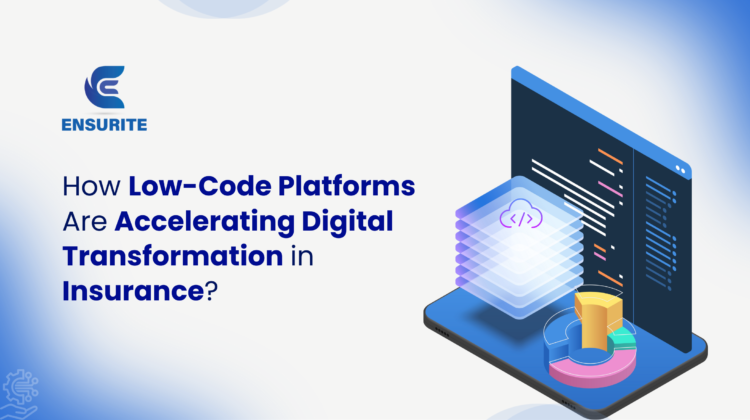
How Low-Code Platforms Are Accelerating Digital Transformation in Insurance?
The insurance industry today is surrounded by many technology systems – policy systems, CRMs, data warehouses, automation tools, and now AI-powered capabilities. Yet what insurers, reinsurers, and distribution partners increasingly need is technology that moves at the speed of business.
This is why low-code platforms are becoming the first choice across the insurance ecosystem.
Despite having multiple systems in place, even simple changes—such as updating a workflow, launching a new product variant, onboarding a new partner, or responding to a regulatory update—often require long development cycles, coordination across multiple teams, and significant rework. With the low-code insurance platform, workflows are built faster, and integrations happen without heavy custom code. Most importantly, business teams don’t have to wait.
Let’s discuss this in this blog. We will explore how low-code platforms are reshaping the insurance industry, enabling them to launch insurance products in the market quickly and deliver services with enhanced accessibility.
Understanding Low-Code in the Insurance Context
Low-code refers to application development platforms that allow users to build software through visual interfaces, configurable logic, and reusable components rather than writing extensive custom code.
When applied to low-code for insurance, the value goes far beyond faster app creation. It directly addresses one of the industry’s biggest bottlenecks: the gap between business intent and technical execution.
Insurance workflows are deeply rule-driven. Eligibility checks, underwriting logic, claims validation, endorsements, renewals- these are processes defined by policy teams and compliance experts, yet historically implemented by developers through lengthy development cycles. A low-code insurance environment collapses this gap by allowing insurers to model rules, workflows, and integrations visually, without sacrificing control or governance.
Why Traditional Insurance Software Is Holding Transformation Back
Most insurers already use multiple forms of insurance software solutions, but these systems were designed in silos:
- Policy administration systems that cannot easily adapt to new product structures
- Claims systems that require months of development for small changes
- Agency portals that lag behind customer expectations
- Back-office tools that rely on manual intervention
The challenge is not the absence of software; it is the inflexibility of existing insurance software development models.
Every change request becomes a project. Every product tweak becomes a release cycle. Over time, insurers accumulate what many CIOs quietly acknowledge as “digital fatigue, the inability to move fast even when the strategy is clear.
A low-code insurance platform changes this equation by introducing modularity, configurability, and rapid iteration into environments that were never designed for speed. Let’s learn what low-code platforms are changing in the insurance industry.
Low-Code Platforms Changing Dynamics in the Insurance Industry
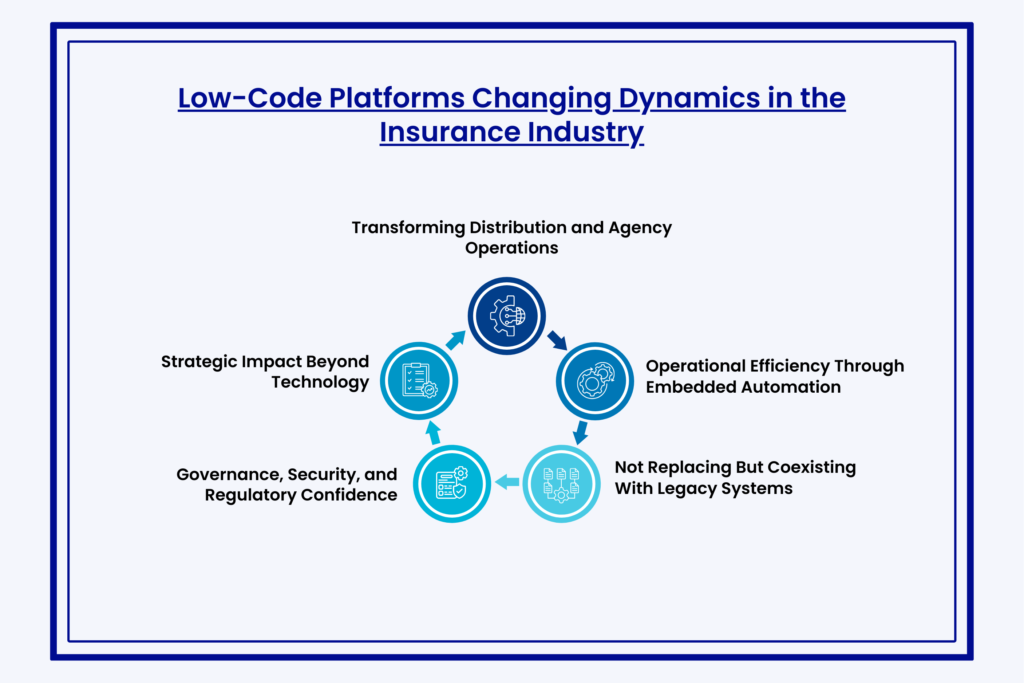
Low-code platforms are reshaping the insurance landscape by introducing speed, flexibility, and control into traditionally complex systems. They allow insurers to adapt processes and launch improvements without disrupting core operations. The following points highlight how low-code platforms are transforming key aspects of the insurance industry.
1.Transforming Distribution and Agency Operations
Distribution remains one of the most operationally challenging areas in insurance. Agents, brokers, and partners often operate on fragmented tools, many of which are outdated or disconnected from core systems.
Modern insurance agency software built on low-code architecture allows insurers to unify these ecosystems while still accommodating different operating models. Agencies gain access to intuitive portals, faster onboarding, and real-time policy visibility. Insurers benefit from standardized workflows and centralized oversight.
A robust insurance agency management software solution also simplifies commission management, policy tracking, and performance monitoring, areas that traditionally consume significant manual effort.
2. Operational Efficiency Through Embedded Automation
Document verification, approvals, and status updates are just a few of the routine, rule-based tasks in insurance operations. A low-code insurance application enables these steps to be automated. It not only automates the processes, but it can also accommodate exceptions that would otherwise cause it to fail. In the long run, it enables insurance companies to eliminate human involvement and shorten turnaround times.
It can also enable more sophisticated functionalities, analytics, decision intelligence, and artificial intelligence without requiring a revamp of the existing framework.
3. Not Replacing But Coexisting With Legacy Systems
A common concern among insurers is whether adopting low-code requires abandoning existing platforms. In practice, the opposite is true.
Many successful firms use low-code to manage workflows and improve the user experience on top of their current insurance software. The old systems still handle the core work, but low-code helps manage processes, connect different systems, and improve how users interact with the software.
This enables insurance companies to update their systems in stages, quickly adding value without the risk of replacing everything at once. That’s why most insurance companies are adopting no-code insurance platforms.
4. Governance, Security, and Regulatory Confidence
Insurance is a regulated industry, and speed without control introduces risk. Exemplary low-code platforms put governance first. It’s built-in, not something to be added on later.
Moreover, these platforms have role-based permissions, audit trails, version control, and embedded compliance. This ensures changes can be easily tracked, controlled, and aligned with regulations.
In many cases, insurers find that adopting structured insurance software solutions built on low-code actually improves governance by replacing ad hoc manual processes with transparent, rule-driven workflows.
5. Strategic Impact Beyond Technology
The true value of low-code lies not only in faster delivery but in organizational alignment. When business and technology teams collaborate on a shared platform, decision-making improves. Feedback cycles shorten. Innovation becomes continuous rather than episodic. Over time, insurers move from reactive transformation initiatives to sustained digital capability.
This is what differentiates a tactical digital project from a true digital insurance solution, one that evolves with the business rather than constraining it.
Takeaway
The insurance industry is changing rapidly, and it’s no longer limited to using the newest tech anymore. It is increasingly about choosing systems that evolve with customers’ expectations and convenience, enabling quicker delivery. Amid this, low-code is turning out to be a beneficial approach for insurance companies to match what they do every day with what they want to achieve.
That’s why we made Ensurite! A platform catering to insurance companies, insurers, MGAs, and agencies, helping them create, launch, and grow their online insurance products easily, overcoming development and maintenance obstructions. Ensurite lets insurance companies update their systems with confidence, with flexible workflows, smooth integrations, and strong governance.
Being quick to adapt is key to being a leader in today’s market. Ensurite gives you more than just software; it sets the stage for lasting insurance changes that are ready for what’s coming. If you’re an insurer wanting to speed things up without losing control, there’s a real solution, and it’s already being used. To know more– Connect with us now!
Explore more Blogs: https://ensurite.solzit.com/blog/
Frequently Asked Questions:
What insurance processes can be automated using low-code platforms?
Low-code platforms can automate a wide range of insurance processes, including policy issuance, endorsements, renewals, claims intake, document verification, approvals, compliance checks, agent onboarding, and commission calculations. These platforms allow insurers to define rule-based workflows that handle routine tasks automatically while routing exceptions for manual review.
How do low-code platforms improve policy management workflows?
Low-code platforms improve policy management by centralizing workflows and making them configurable rather than hard-coded. Insurers can adjust policy rules, coverage structures, and lifecycle events without system downtime. This results in faster policy updates, reduced errors, better visibility across departments, and smoother coordination between underwriting, operations, and distribution teams.
How does low-code development reduce operational costs for insurers?
Low-code development reduces operational costs by minimizing custom development effort, lowering maintenance overhead, and reducing reliance on large IT teams for routine changes. Automation of manual processes further cuts processing time and error-related costs. Over time, insurers achieve higher productivity with fewer resources while avoiding expensive system overhauls.