Building a Composable Insurance Ecosystem for Scalability & Flexibility
The insurance sector is undergoing one of its most consequential shifts in decades. Market volatility, evolving customer expectations, regulatory complexity, and rapid technological advancement are pushing insurers to rethink how they design, operate, and scale their businesses. Traditional, monolithic systems, once sufficient for predictable product lines and stable distribution models, are now proving restrictive. In response, forward-thinking insurers are moving toward a composable insurance ecosystem that prioritizes adaptability, speed, and long-term resilience.
A composable insurance ecosystem allows insurers to assemble their technology stack from modular, interoperable components rather than relying on rigid, all-in-one platforms. This approach does not simply modernize IT infrastructure; it fundamentally changes how insurers innovate, collaborate, and respond to change. As digital transformation in the insurance industry accelerates, composability has emerged as a practical strategy for achieving both scalability and flexibility without compromising operational stability.
Understanding the Concept of a Composable Insurance Ecosystem
At its core, an insurance ecosystem built on composable principles is designed around loosely coupled services, APIs, and cloud-native components. Each module, whether it supports underwriting, policy administration, claims processing, or customer engagement, can function independently while integrating seamlessly with the broader system. This architectural philosophy enables insurers to replace, upgrade, or expand capabilities without disrupting the entire operation.
Unlike traditional insurance industry solutions that bind multiple functions into a single platform, a composable insurance ecosystem gives organizations the freedom to select the best tools for specific needs. Insurers can integrate specialized insurance management software, adopt a modern digital distribution platform, or layer advanced analytics without being constrained by a vendor’s conditions.
This composability is increasingly critical as the future of insurance demands faster innovation cycles and more personalized offerings.
Why Scalability and Flexibility Are Now Strategic Imperatives
Insurance is no longer a slow-moving industry! Customer behavior has shifted toward digital-first interactions, on-demand services, and transparent pricing. At the same time, new entrants, particularly insurtechs, are redefining expectations by launching products faster and operating with leaner cost structures. To remain competitive, insurers must scale efficiently while retaining the flexibility to pivot when market conditions change.
A composable insurance ecosystem supports horizontal and vertical scalability. Insurers can expand into new geographies, introduce new product lines, or onboard additional digital insurance distribution partners without reengineering their entire technology stack. This level of agility is difficult to achieve with legacy systems that were never designed for rapid growth or frequent change. As technology in the insurance industry continues to evolve, scalability is no longer just about volume but more about responsiveness.
How a Composable Insurance Ecosystem Powers Modern Insurance Capabilities
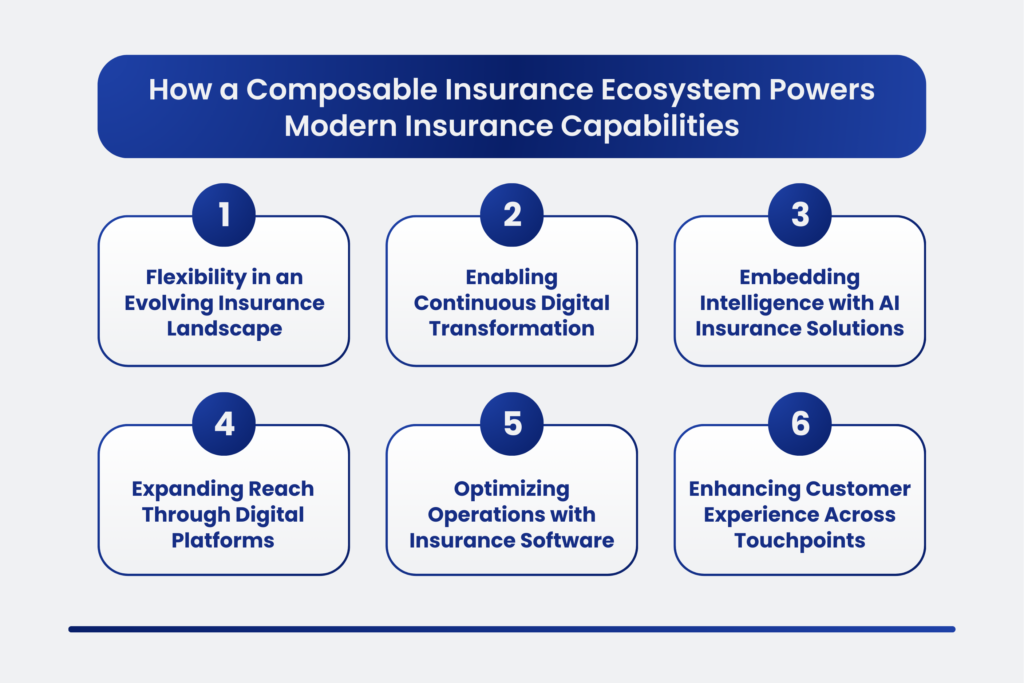
A composable insurance ecosystem creates a unified yet modular foundation that supports the full spectrum of modern insurance capabilities. Once scalability is established, this architecture enables insurers to operate with greater agility, embed intelligence into workflows, modernize incrementally, and deliver consistent customer experiences. Rather than treating flexibility, digital transformation, and innovation as separate initiatives, composability aligns them under a single, coherent system design.
1. Flexibility in an Evolving Insurance Landscape
Flexibility allows insurers to respond quickly to regulatory updates, market shifts, and emerging risk models without disrupting core operations. A composable insurance ecosystem enables localized changes by decoupling system components, reducing interdependencies that slow innovation. This ensures insurers can adapt policies, processes, and compliance requirements efficiently while maintaining operational stability.
2. Enabling Continuous Digital Transformation
Digital transformation in the insurance industry is most effective when approached as a continuous process rather than a one-time upgrade. Composable architecture supports phased modernization, allowing insurers to digitize processes, automate workflows, and enhance systems incrementally. This controlled evolution minimizes risk and ensures that digital insurance solution investments remain aligned with business priorities.
3. Embedding Intelligence with AI Insurance Solutions
AI insurance solutions deliver meaningful impact when integrated directly into underwriting, claims, and fraud detection workflows. A composable insurance ecosystem allows AI capabilities to function as independent modules, enabling insurers to test, scale, or refine AI-driven processes without reworking core platforms. This approach ensures responsible adoption while maximizing operational and analytical value.
4. Strengthening Reach Through Digital Distribution Platforms
A modern digital distribution platform enables insurers to support multiple channels, including agents, partners, and direct-to-consumer models. Within a composable insurance ecosystem, distribution layers operate independently yet remain tightly integrated with core systems. This structure accelerates partner onboarding, supports market expansion, and ensures consistent pricing and policy governance across channels.
5. Optimizing Operations with Insurance Management Software
Efficient operations depend on modular insurance management software that supports policy administration, claims processing, billing, and endorsements. By treating these functions as independent services, insurers can modernize and automate specific areas without affecting stable processes. This targeted optimization improves efficiency, reduces maintenance overhead, and enhances overall operational resilience.
6. Enhancing Customer Experience Across Touchpoints
Customer experience improves when data flows seamlessly across systems and channels. A composable insurance ecosystem enables a unified view of customer interactions, supporting faster service, personalized engagement, and consistent experiences. Real-time access to information strengthens transparency and trust, positioning customer experience as a strategic differentiator rather than a byproduct of operations.
Preparing for the Future of Insurance
The future of insurance will be shaped by continuous change, new risk models, evolving regulations, and rapid technological advancement. Digital insurance solutions for insurers that rely on static systems will struggle to adapt. Those who invest in a composable insurance ecosystem will be positioned to evolve continuously.
Composable architecture allows insurers to test new ideas, adopt emerging technologies, and refine business models without destabilizing operations. As technology in the insurance industry continues to advance, this adaptability will define which organizations lead and which fall behind.
Final Thoughts
Building a composable insurance ecosystem is not merely a technical upgrade; it is a strategic shift in how insurers design for growth, resilience, and innovation. At Ensurite, this philosophy is central to how modern insurance platforms are engineered, through modular, API-led architectures that give insurers the scalability to expand confidently and the flexibility to adapt intelligently.
As digital transformation in the insurance industry accelerates, composability provides a clear path forward, one that aligns technology with business vision and prepares insurers for an increasingly dynamic future. With Ensurite enabling this transition through purpose-built insurance technology solutions, insurers gain a robust foundation to navigate uncertainty and build sustainable, future-ready insurance ecosystems. Are you ready to transform with an excellent composable insurance ecosystem? Connect with our expert now, and start today!
Explore more Blogs: https://ensurite.solzit.com/blog/
Frequently Asked Questions:
How does a composable ecosystem improve scalability for insurance businesses?
A composable ecosystem improves scalability by enabling insurers to scale specific services independently based on business demand. Instead of expanding or upgrading an entire platform, insurers can add capacity to individual components, launch new products faster, and enter new markets without system-wide performance or cost constraints.
What technologies enable a flexible and modular insurance ecosystem?
Cloud-native infrastructure, microservices architecture, API frameworks, and event-driven systems enable a flexible insurance ecosystem. Supporting technologies such as AI insurance solutions, data analytics platforms, and modern insurance management software further enhance modularity and interoperability across systems.
What are the main benefits of adopting a composable architecture in insurance?
The primary benefits include greater flexibility, faster innovation, reduced dependency on single vendors, improved operational efficiency, and lower long-term technology risk. A composable architecture also supports continuous digital transformation, allowing insurers to evolve incrementally while maintaining system stability.
How can insurers choose the right technology partners for building a composable ecosystem?
Insurers should select technology partners with proven insurance domain expertise, strong API capabilities, and experience delivering modular, scalable platforms. The right partner should support open integration, align with long-term business strategy, and demonstrate the ability to evolve alongside regulatory, market, and technological changes.