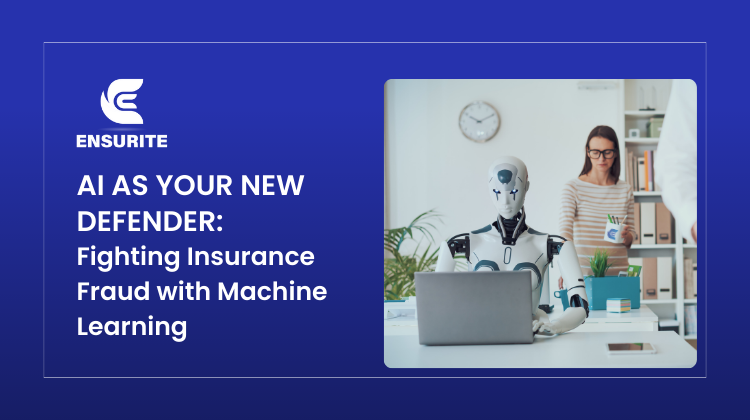
AI as Your New Defender: Fighting Insurance Fraud with Machine Learning
Do you know that, as per the resource “Life insurance fraud alone costs nearly $75 billion annually, while property & casualty fraud accounts for about 10% of industry losses, totaling around $122 billion.”
Insurance fraud, ranging from false claims to identity theft, costs the global insurance industry billions annually. Traditional approaches, like manual audits and fixed rules, are overwhelmed by the sheer volume and complexity of modern fraud.
However, with AI fraud prevention, artificial intelligence fraud detection systems can sift through massive data within seconds. These technologies embed fraud prevention with machine learning into every stage, from insurance distribution to policy servicing, making AI in insurance a game-changer.
Digital insurance distribution channels benefit from early fraud detection, enhancing trust and efficiency. Wondering what more comes when AI becomes your defender against insurance fraud? Let’s explore together in this blog.
Understanding the Tools: Machine Learning and AI in Action
By embedding AI fraud detection insurance solutions into insurance workflows, insurers can proactively identify suspicious activities. One of the core elements of AI and ML, i.e, automation, if integrated in insurance, ensures consistency and supports agents with real-time insights. To understand how AI and ML defend you against insurance fraud, let’s learn about the tools.
AI Fraud Prevention Tech: The Basics
To understand precisely, AI fraud prevention is about pattern recognition and anomaly detection. Artificial intelligence fraud detection tools use comprehensive models, supervised, unsupervised, and reinforcement learning, to flag inconsistencies. With fraud prevention with machine learning, insurers train systems on historical claims, analyzing what genuine behavior looks like versus fraudulent attempts.
As fraudsters change their tactics, these models continue to learn and evolve. This adaptability makes AI-driven fraud detection dynamic and resilient, helping insurers identify unusual activity faster and with greater accuracy.
Where Automation Strengthens the Process
Fraud detection doesn’t happen in isolation—it’s tied to the way insurance is distributed and managed. In the past, manual paperwork, long verification cycles, and agent-only reviews created loopholes that fraudsters could exploit.
Now, automation in insurance distribution not only handles eligibility, underwriting, and claims classification. But it also builds in stronger fraud controls. For example:
- Agents receive real-time fraud alerts within their workflows.
- Digital insurance platforms flag suspicious claim inputs or login patterns during online interactions.
- Automated checks reduce human error, making fraud harder to slip through unnoticed.
This integration of AI fraud detection and automation transforms the customer journey. It ensures fraud prevention is not just a back-end safeguard but a seamless, proactive layer of protection throughout the insurance process.
Key Techniques in AI Fraud Prevention with Embedded Machine Learning
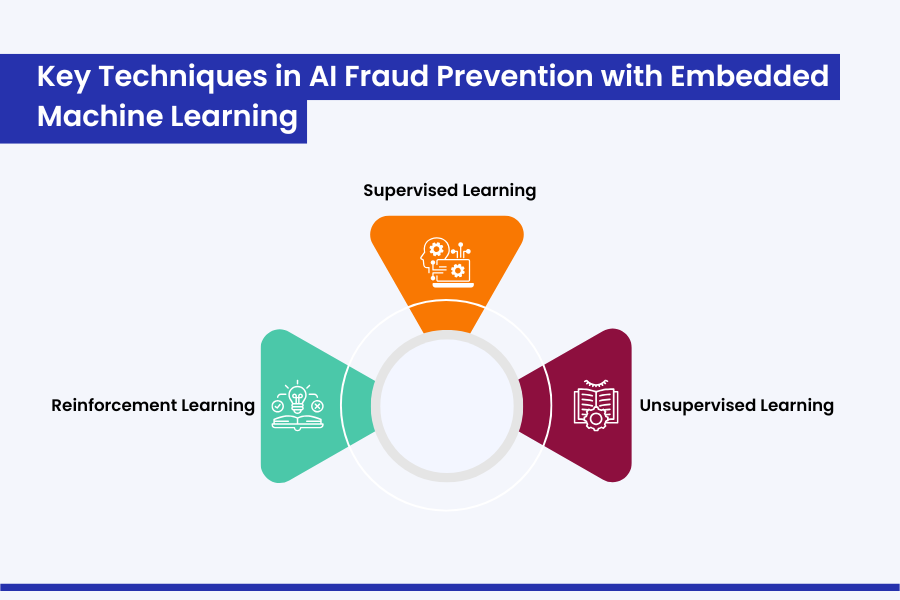
While we have discussed how artificial intelligence and machine learning are significant contributors to defending insurance companies against fraud, let’s now learn about the tools behind the effective process and how they work.
- Supervised Learning
This method uses labeled datasets from previous fraud cases vs. legitimate ones. Algorithms learn to differentiate, enabling AI fraud detection insurance tools to assign risk scores. Claims with elevated suspicion are flagged for further review, or even auto-denied, to preserve integrity.
This technique anchors AI fraud prevention within automation in insurance workflows, enabling rapid decision-making without sacrificing accuracy. - Unsupervised Learning
There are multiple cases of fresh or new fraud, with no historic label to practice defense against them. That’s where unsupervised methods perform their role. Models like clustering or isolation forests (which are designed for anomaly detection) detect deviations from typical claim patterns. This approach of fraud prevention with machine learning allows AI in insurance systems to spot emerging threats.
When integrated into insurance agency automation systems, such models quietly monitor all claims, alerting agents instantly when something looks suspicious. - Reinforcement Learning
Here, systems learn via trial and error. A fraud model is rewarded for correctly catching fraud and penalized for misses. Over time, artificial intelligence fraud detection becomes increasingly accurate. This dynamic approach elevates AI fraud prevention beyond static rulesets
When embedded in digital insurance distribution, these adaptive models help refine claim workflows, balancing speed, cost, and security.
Strategic Benefits of AI Fraud Prevention
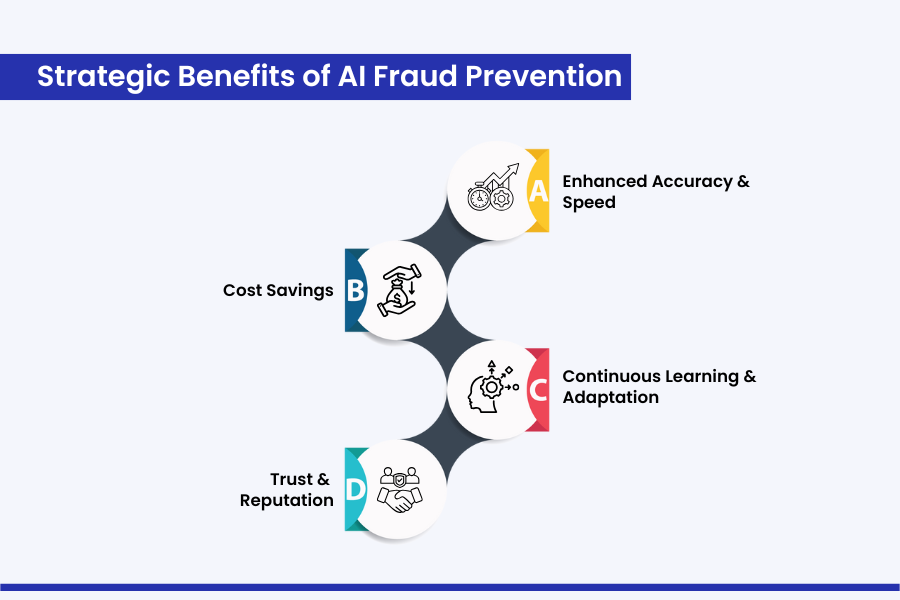
AI fraud prevention doesn’t just enhance efficiency and improve trust-building factors for insurance companies, but also drives them to some strategic benefits. Study them below:
- Enhanced Accuracy & Speed
Manual audits are slow, tedious, and costly. By contrast, AI offer millisecond-level screening across thousands of claims backed by fraud prevention with machine learning models. This improves both accuracy, by learning complex patterns, and speed, by fully automating repetitive tasks.
Additionally, insurance agency automation means agents aren’t bogged down with mundane tasks. They can focus on customer service and stay confident that AI in insurance systems flags only the genuinely risky cases. - Cost Savings
Fraud costs increase, whether through payouts, compliance, or investigation. Automation in insurance, powered by AI fraud prevention, cuts down overheads. Digital workflows reduce human labor costs, while early detection lowers fraudulent payouts. Digital insurance distribution gains efficiency from front-loading fraud checks, stopping malicious activities before they cause hefty monetary loss. - Continuous Learning & Adaptation
Artificial intelligence fraud detection keeps evolving as per the modern risks. Fraud prevention with machine learning models refines itself as fraudsters shift their strategies. In insurance distribution, this continuous adaptation ensures you’re always one step ahead and safeguarded even from the newest fraudulent challenges. - Trust & Reputation
Consumers and regulators increasingly demand transparency and fairness. With AI insurance fraud detection tools, insurers can document automated decisions, audit them, and demonstrate compliance. Insurance agency automation and digital insurance distribution systems make every step easy to track and trustworthy for the consumers.
Fintech, being a severely perilous industry, can no longer rely on manual audits and fraud checks. However, integrating AI fraud prevention in your insurance setups can be challenging for anyone, but especially for those new to the industry. Hence, here is your manual on how you can build a robust AI fraud prevention strategy to empower your insurance setup and protect it against fraud, and strengthen customer trust.
Building a Robust AI Fraud Prevention Strategy
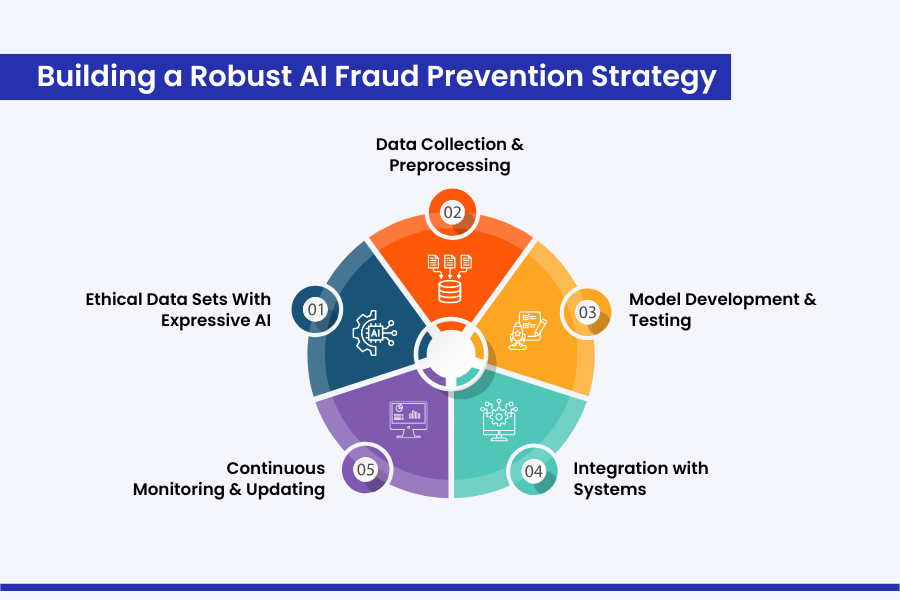
Make a robust fraud prevention insurance setup backed by AI and machine learning. Here is how insurers can put it into practice:
- Data Collection & Preprocessing:
Gather claim data, transaction history, customer backgrounds, and payment details. Ensure standardized formats, deduplication, and privacy compliance. Clean and reliable data provide a strong foundation for fraud prevention with machine learning. - Model Development & Testing:
Construct supervised and unsupervised models, tune them, and test them on separate validation sets. Test them on separate validation sets until error rates fall within acceptable ranges. Incorporating reinforcement learning helps models adapt as fraud tactics evolve, making prevention strategies more concrete. - Integration with Systems:
Embed AI-driven fraud detection into insurance agency automation platforms and digital distribution channels. Equip agents with real-time alerts, risk scoring dashboards, and feedback loops, enabling models to improve continuously. - Continuous Monitoring & Updating:
Schedule regular training based on new fraud patterns. Monitor false positives and negatives. Regularly evaluate AI fraud detection insurance performance. The automation in insurance processes prevents anomalies from slipping through unnoticed. - Ethical Data Sets With Expressive AI:
Regulators and customers demand fairness and transparency! Use methods that explain why an alert was raised, e.g., feature contribution. This reinforces trust in your AI in insurance systems and defends against disputes.
Forward-thinking insurers are already investing in AI-driven fraud prevention frameworks—or partnering with experts who can help them implement one. The fintech landscape is evolving quickly, and fraud tactics are only getting smarter.
But the real question is, are you prepared to deal with the fintech future, which is highly driven by AI? Let’s have a better view of the same.
The Future: AI-Driven Insurance Frameworks
Looking ahead, AI in insurance evolves beyond claims. What are the future possibilities you can expect the insurance industry to advance with? Let’s see!
- Predictive Underwriting:
AI evaluates risk at quote initiation, embedding AI fraud prevention before policies are issued. - Chatbot Claim Intake:
Natural language bots ask analyzing questions. Artificial intelligence fraud detection flags odd or inconsistent responses. - Cross-Organization Insights:
Shared data sets allow fraud prevention with machine learning to spot fraud buzzes across carriers.
These developments place AI insurance fraud detection at the core of insurance architecture, ever-present in automation in insurance and insurance distribution chains.
The Takeaway:
In an era where insurance fraud is growing fiercely by the day, the need for intelligent, adaptable, and reliable solutions is greater than ever. By harnessing the power of AI fraud prevention, artificial intelligence fraud detection, and fraud prevention with machine learning, insurers can protect their operations, preserve trust, and enhance profitability.
The future of AI in insurance lies in seamlessly integrating these innovations into everyday workflows, ensuring faster claim resolutions, stronger fraud defenses, and improved customer satisfaction.
This is where Ensurite steps in as your trusted technology partner. Specializing in AI insurance fraud detection, automation in insurance, and digital insurance distribution, Ensurite empowers insurance companies to combat fraud proactively while streamlining their entire insurance distribution process.
From implementing intelligent risk assessment tools to enabling insurance agency automation that delivers real-time fraud alerts, Ensuite provides end-to-end solutions tailored to your needs. Partner with Ensurite, and let innovation be your strongest defense against fraud! Connect with our experts now.
Explore more Blogs: https://ensurite.solzit.com/blog/
Frequently Asked Questions:
Are AI-driven fraud prevention systems secure and compliant with regulations?
Yes, robust AI-driven fraud prevention systems increase operational efficiency for enterprises. Moreover, they are secure and compliant with regulations.
How can insurers integrate AI fraud detection into their existing systems?
To integrate AI tools, use APIs or cloud-based platforms that allow insurers to connect fraud detection models with their claims processing or policy management systems.
Does AI also help reduce false positives in fraud detection?
Yes! AI helps insurance companies reduce false positives in fraud detection over time by learning from previously saved data. It helps AI to differentiate between genuine and fraudulent claims, which eventually helps in reducing false alarms.
Can AI improve customer trust by reducing fraudulent activities?
Absolutely, in fact, AI can be a significant player for insurance companies to improve their customer trust by reducing fraudulent activities. It minimizes fraud, allowing insurers to ensure fair pricing, faster claim settlements, and a transparent process, which strengthens customer confidence.